
Why Your AI SEO Strategy Needs to Evolve for Meaningful KW Conversations

If you’re still optimizing your content around short, generic keywords like “plumber” or “coffee shop,” you’re already invisible to the next wave of customers.
Search has fundamentally changed—not just a little, but completely. The rise of AI-powered search (think ChatGPT, Perplexity, Google SGE) and hyper-personalized, geo-targeted results means users no longer type in one or two words and scroll through endless blue links. Instead, they’re asking conversational, hyper-specific questions like:
Who installs energy-efficient windows in older bungalows in North Seattle?
These queries don’t fit neatly into a 2-word keyword strategy. They reflect real-life intent, tied to location, context, and nuance. And they’re being parsed, interpreted, and answered by large language models (LLMs) that value semantic richness and human-like relevance over keyword stuffing.
This shift means two urgent things for your SEO strategy:
- You’re not just optimizing for algorithms anymore—you’re optimizing for AI models trained to understand real people.
- Generic content won’t rank, won’t convert, and won’t get seen in a GEO/LLMEO world.
To stay visible and competitive, you need to target long-tail keywords that match how people speak and search, especially when they’re looking for something local, personal, or situational.
The Evolution of Search: From Keywords to Questions
Search behavior has fundamentally shifted over the past decade, and AI is accelerating that change faster than ever.
From Keywords to Conversations
In the past, users searched with short, generic keywords like:
“plumber near me”
“best Italian food”
But today, searchers are more likely to ask full, nuanced questions, such as:
“Who’s the most reliable plumber in Atlanta for same-day emergency service?”
“Where can I find homemade pasta in Boston with gluten-free options?”
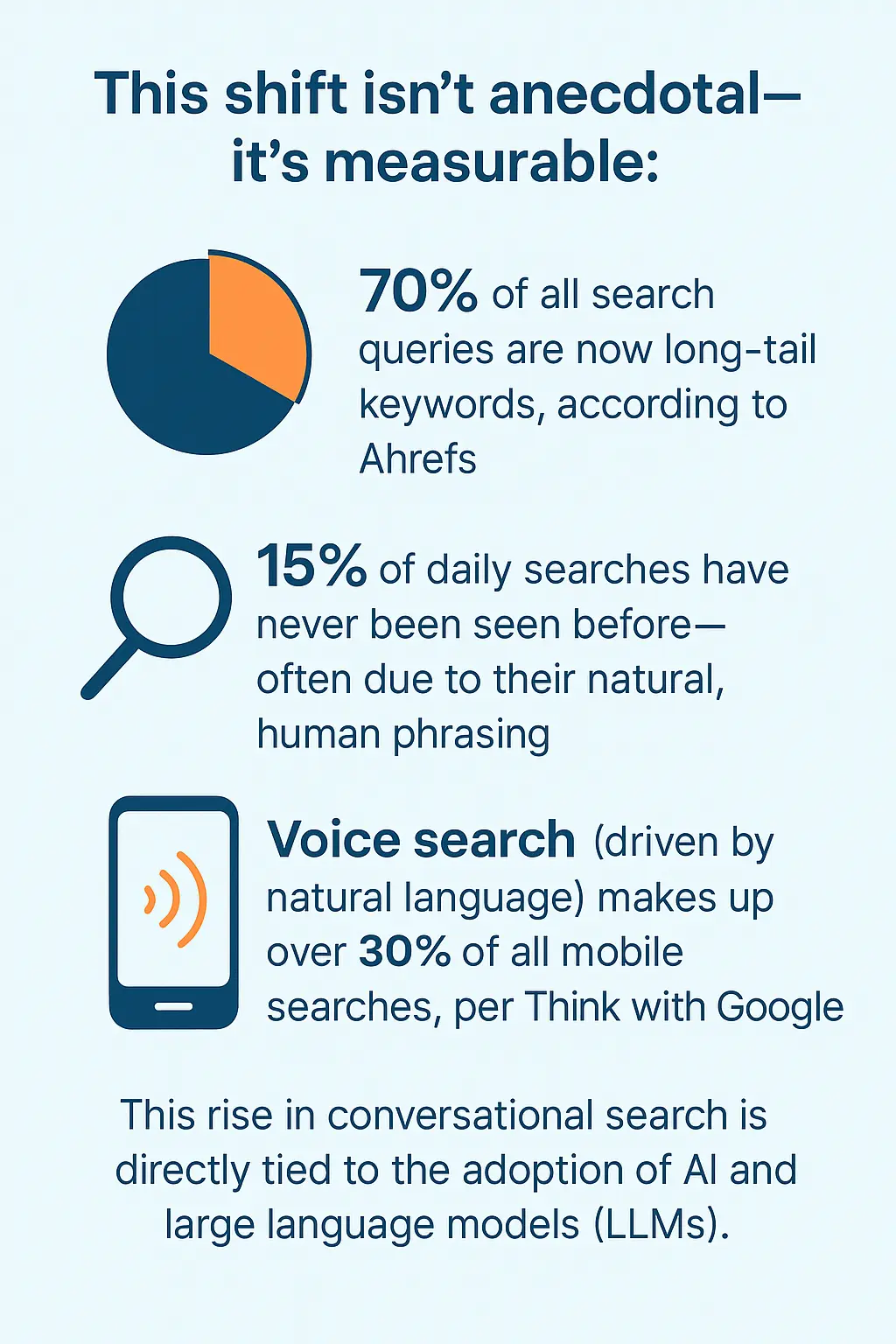
How Long-Tail GEO Search Has Evolved in the Age of AI
Long-tail keywords were once considered SEO’s “low-hanging fruit”—less competitive, lower volume, and easy wins. But that old definition doesn’t hold up anymore.
Today, long-tail isn’t just about low competition—it’s about real conversation.
Thanks to AI-powered search and chat interfaces, especially those powered by LLMs (Large Language Models), people no longer search in fragmented phrases. They ask full questions, make specific statements, and expect direct, personalized answers.
From Location-Based Keywords to Conversational Intent
Old long-tail (pre-LLM):
“affordable plumbers in Miami”
Modern long-tail (LLM-driven):
“Who’s the most affordable plumber in Miami that can come out tonight and has good reviews on Yelp?”
Old long-tail (static and SEO-tweaked):
“best cafes Austin downtown”
Modern long-tail (context-aware and task-driven):
“Is there a quiet coffee shop in downtown Austin with strong Wi-Fi and outdoor seating that’s open past 9pm?”
These queries are richer, more specific, and more human—and they’re how AI tools are being prompted every day.
Leads Now Phrase Searches as Questions or Tasks
Thanks to tools like ChatGPT and Google SGE, users are phrasing local intent with directives, comparisons, and qualifiers. You’re no longer targeting keywords. You’re targeting:
- Decisions
“Which gym in Scottsdale offers beginner boxing classes with female instructors?” - Constraints
“Looking for a massage therapist in Boulder under $100 who accepts walk-ins.” - Comparisons
“Compare hair salons in Koreatown with the best balayage reviews and weekend availability.” - Situational requests
“Where can I get a flat tire fixed fast near Hollywood Blvd on a Sunday?”
This is how your real leads are phrasing their needs—not as abstract keywords, but as actionable, location-anchored questions.
Why This Matters for Local Visibility
Traditional SEO might still help you rank for “personal trainer San Diego.” But if a lead is asking Perplexity or ChatGPT:
“Who’s the best-rated female personal trainer in San Diego who specializes in postpartum fitness and trains at home?”
Your generic page with short-tail keywords won’t even register.
AI-driven platforms are trained to prioritize content that:
- Reflects full intent
- Matches conversational phrasing
- Includes localized, human-level detail
If your content doesn’t answer that exact kind of query—or close variants of it—you’re invisible in AI search environments.
Geo + Long-Tail Today = Decision-Level SEO
Modern long-tail SEO isn’t about stuffing keywords. It’s about:
✅ Anticipating real decision-making moments
✅ Addressing specific user needs in a geo context
✅ Structuring content to sound like how people actually ask
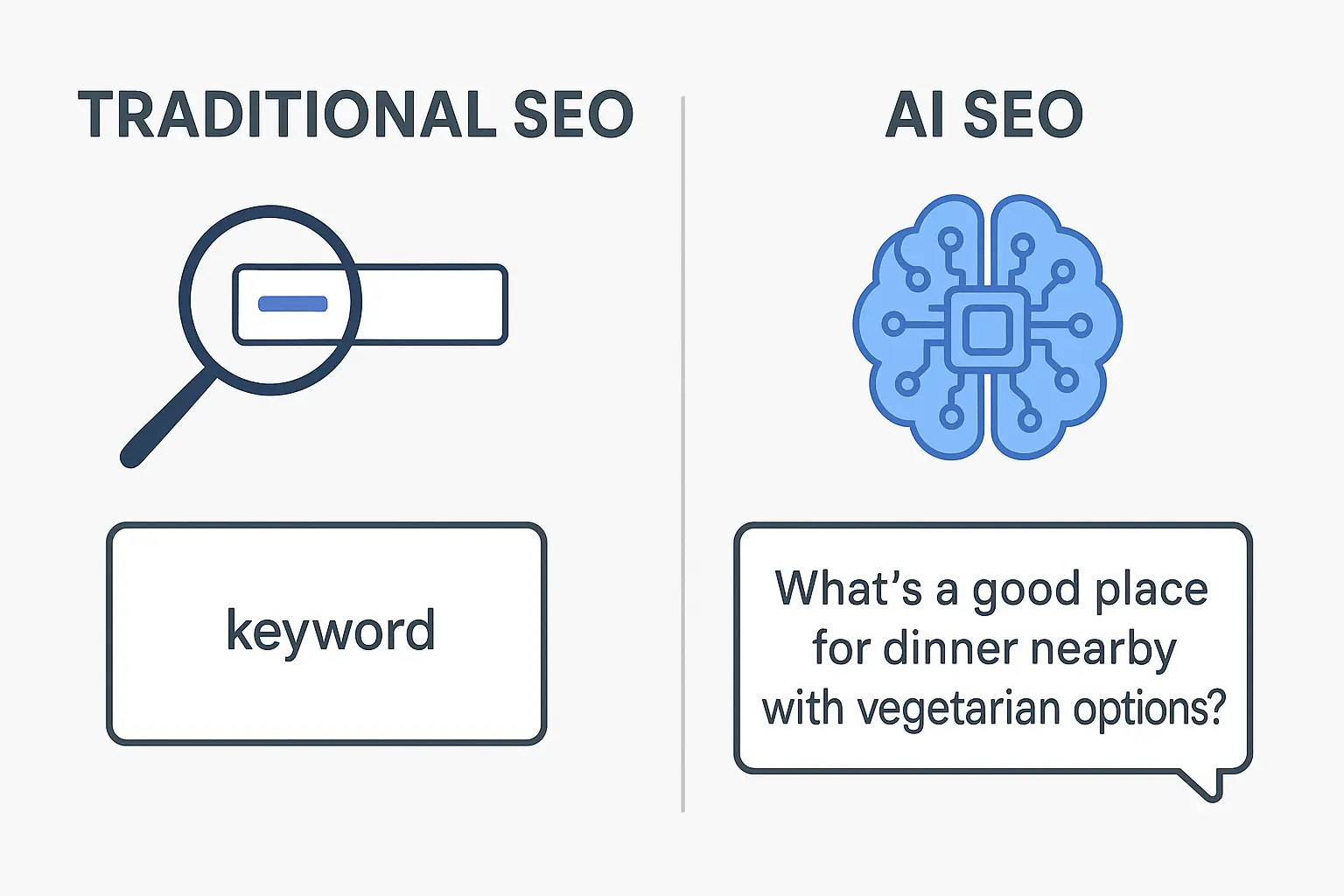
How to Adapt Your Content for AI SEO (Without Killing What Already Works)
Let’s say you’ve spent years perfecting your SEO content. Your blog ranks for high-intent keywords. Your landing pages convert. Your product/service pages are clear, keyword-optimized, and deliver ROI.
But now… you’re hearing things like:
“You need to rewrite everything for ChatGPT.”
“Google SGE favors conversational content now.”
“Your pages are too robotic, too keywordy, too 2017.”
You start to panic.
What if optimizing for AI messes up what’s already working?
What if rewriting your copy breaks your current rankings?
What if ‘humanizing’ your content actually confuses Google?
The Pain Point: You Built for Bots, Not for People + AI
Let’s break this down with a few hypotheticals:
🧱 Your Local Service Page
Your “HVAC repair in Charlotte” page ranks #2 for that exact term. But it’s stiff, robotic, and over-optimized.
Now someone asks ChatGPT:
“Who’s the best emergency HVAC service in Charlotte that offers 24/7 support and fair pricing?”
LLMs don’t care about your keyword density. They care about answers—and you’re not offering one in plain, helpful language.
📃 Your Blog Posts
You wrote blog posts with intros like:
“If you’re looking for a content marketing agency in Tampa, you’ve come to the right place. At XYZ Agency, we are a Tampa content marketing agency that helps…”
Great for 2015 SEO. But in 2025, AI ranks you lower because it ignores shallow intros and rewards substance early.
The Solution: Evolve, Don’t Erase
You don’t need to delete everything and start over. Instead, shift from “keyword-stuffed and static” to “conversational and context-aware.” Here’s how:
1. Keep the Core, Layer the Context
Instead of rewriting pages from scratch:
- Keep your original optimized headers, structure, and main topics.
- Add FAQ sections, scenario-based questions, or user-driven context that aligns with real AI queries.
Example:
Add an FAQ: “Who do you serve for late-night HVAC repairs in Charlotte?”
Add a block: “Why homeowners in Myers Park call us for urgent A/C issues.”
This adds semantic relevance without undoing your keyword footprint.
2. Identify “AI Blind Spots” in Existing Content
Use ChatGPT or Claude to simulate what a potential customer might ask.
Prompt:
“What would someone ask an AI tool if they were looking for [your service] in [your city]?”
Compare that to what your page says.
✅ If the answer is clear, concise, and conversational, you’re good.
❌ If the answer is buried, vague, or too keyword-heavy, rewrite that block in human-first language.
3. Reframe SEO Copy as Real Answers
Search is now answer-driven. That means:
- Turn listicles into decision guides
- Turn product pages into solution explainers
- Turn static service pages into helpful, scenario-based content
Instead of writing:
“Our services are fast, affordable, and expert-level.”
Write:
“We’ve helped over 300 Atlanta homeowners fix burst pipes within 2 hours—here’s what you can expect when you call us after hours.”
4. Add Modular “AI-Friendly” Elements Without Redesign
LLMs thrive on structure. You don’t need to redo your site—just inject modular chunks like:
- “Top 5 reasons locals trust us”
- “What to know before booking a [service] in [city]”
- “Can’t decide between X and Y? Here’s how we help you choose.”
These contextual bridges make your content AI-digestible while keeping your original SEO foundation intact.
TL;DR: You Don’t Have to Burn It Down—Just Humanize It Smartly
✅ Keep what’s ranking
✅ Add what’s missing
✅ Speak how your leads search
Success in GEO doesn’t come from “replacing SEO with AI”, it comes frommaking your content findable, readable, and recommendable in both search engines and language models.

Real-Time Tactics from the Front Lines of AI + GEO SEO
To stay ahead in the rapidly evolving world of search, here are three expert-backed strategies shared in the last few months by marketers adapting their content for LLMs, zero-click AI interfaces, and local discovery trends:
Tip 1: Structure Content for AI Citation (Generative Engine Optimization)
Content creators should shift from wall-of-text pages to bite-sized, AI-friendly formats—think bullet points, comparison tables, and concise, scan-ready passages. This makes your content more citable in AI-generated responses like ChatGPT, Gemini, or Google AI mode.
Tip 2: Embrace the Rise of Zero-Click and AEO-Driven Trends
With AI interfaces becoming search defaults for many users, traditional SEO must now coexist with AEO. This means optimizing pages not just for rankings, but for being the authoritative answer across clusters of related questions, prioritizing relevance to AI responses over pure keyword targeting.
Tip 3: Adapt Core Structure Without Rewriting Everything
Rather than scrapping your high-performing content, evolve it. Continue using traditional SEO best practices—keywords, backlinks, structured data but also augment with contextual, trust-building elements (e.g., FAQs, updated Q&A, and freshness signals) that signal clarity and relevance to LLMs
Conclusion: Adapt or Get Left Behind—AI Isn’t Waiting
Search as we knew it is over. AI isn’t the future—it’s already the filter your next customer is using.
Every day, potential leads are asking ChatGPT, Gemini, or Perplexity deeply specific, local, intent-driven questions—and most businesses? They’re still writing like it’s 2018. Keyword-stuffing. Vague service pages. Ignoring how real people search when they’re ready to act.
If your content doesn’t evolve, it won’t just lose rankings.
It’ll disappear entirely from AI-generated answers, maps, and recommendations.
But here’s the opportunity:
The brands who embrace long-tail, geo-targeted, AI-optimized content right now?
They’re going to own the next generation of discovery—before their competition even realizes what changed.
Ready to future-proof your SEO?
Book a free strategy call with our team at Vash Studios.
We’ll audit your current content, identify your AI visibility gaps, and build a custom GEO + LLMEO plan designed for how people actually search today.